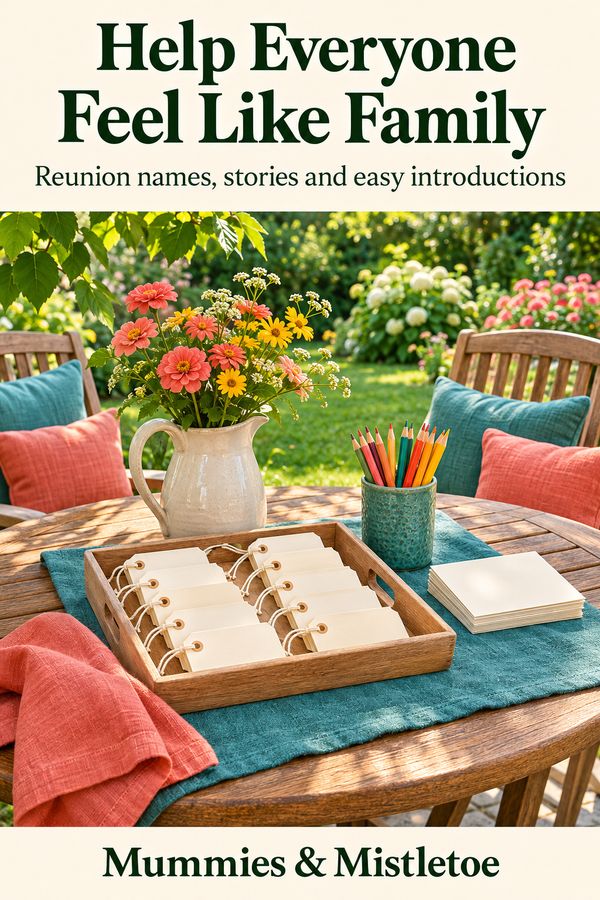
At a large family reunion, “You remember who this is, don’t you?” is not much of an introduction. Names change, children grow up, and some relatives have never met at all.
A welcoming name-and-story system helps people connect without making anyone prove that they already understand the family tree.
Let everyone choose how to be introduced
Ask guests for the name they want on their tag and an optional pronunciation note. Use the same approach for partners, friends, and chosen family invited to the gathering.
A name alone works well; guests who enjoy it can add how they connect to the hosts.
Use large readable lettering. A name tag should be useful across a conversation, not a miniature genealogy document.
Add one conversation doorway
Offer a second line such as “Ask me about…” Guests can choose a hobby, a place they enjoy, a favorite family recipe, or a current interest. It gives people something to say beyond explaining their relationship.
Provide a blank option too. Nobody needs to advertise an interesting fact to belong at the table.
Children can draw a favorite thing beside their names.
Use a family map only if it helps
A simple relationship map can orient people who are meeting for the first time. Let guests help describe the connections.
Keep private family history and identifying details off anything displayed or shared.
Consider a looser map of households or “people who came together” if a formal tree would exclude or confuse guests. The purpose is orientation, not defining who counts.
Give hosts a better introduction habit
Introduce people with names and one shared point of interest: “Maya, this is Chris. You both love restoring old furniture.” Then leave room for them to talk.
A hobby, recipe or shared place gives two people an easy beginning.
Ask a few outgoing guests to help make introductions, but do not assign them responsibility for entertaining everyone. Small thoughtful connections are enough.
Collect stories without creating an interview booth
Place a few optional prompts near a quiet table: “A place our family used to gather,” “A food you remember,” or “A person who taught you something.” Guests can write, draw, or talk with someone who volunteers to take notes.
Written notes are a simple way to collect the stories. Invite storytellers to read their notes and add any detail they remember.
Gather the notes into a family collection and tell people how they can add another memory later.
The best reunion system becomes almost invisible once conversation starts. It helps someone move from “I don’t know who that is” to “We found something to talk about,” which is a very good beginning.