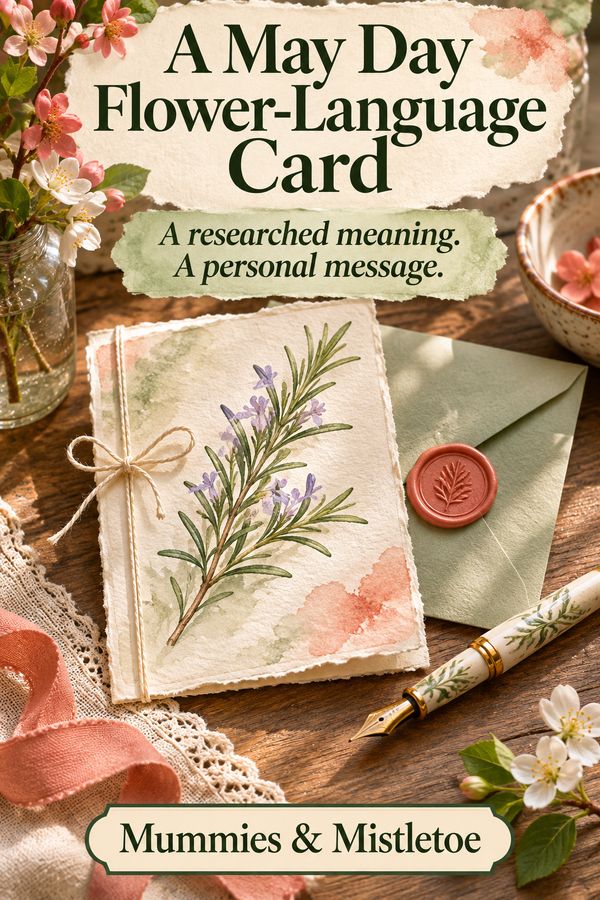
For May Day, make a flower-language card with a message the recipient can understand. Choose one flower or herb, learn where its meaning comes from and write a note that makes the connection personal.
For May Day, this can be a drawing on a folded card, a photograph you took or a small illustration you create yourself. You do not need an elaborate bouquet to make a thoughtful gesture.
Choose a meaning with a source
The Royal Horticultural Society’s history of the language of flowers explains that different writers assigned different meanings. There was not one universally consistent floral dictionary.
One example the RHS discusses is rosemary’s association with remembrance, familiar from Shakespeare’s Hamlet. That gives you a clear starting point for a card to someone you have been thinking about.
If you prefer another flower, look up a specific source and record it. Avoid presenting a meaning from one book as a fact shared by every culture and period.
Turn the meaning into your own message
Use the historical association as a beginning, then say something personal. For rosemary, you might write: “This little sprig is for remembering our walks together. I’m thinking of you as May begins.”
Name a shared moment, a quality you appreciate or a hope for the coming season. The recipient should not need to decode the illustration to understand why you sent it.
Keep the note short enough to read comfortably. A few specific sentences usually carry more warmth than a paragraph of flower symbolism copied from a website.
Make the front simple
Draw one sprig or blossom with room around it. Use a reference photograph you took or have permission to use, and keep the image recognizably connected to the plant you researched.
Write the plant’s name in small lettering on the back or inside. Add a brief source note if the historical meaning is part of the message. That makes the card interesting without crowding its design.
If drawing feels intimidating, make a simple outline and use one or two colors. The personal note is doing much of the work.
Decide whether to add a real plant
A paper card is enough. If you want to include a plant or cutting, ask whether the recipient would enjoy it and consider household pets, children, allergies and the plant’s care needs. Do not treat every decorative plant as safe to eat or handle.
Use a florist or reliable gardening source for plant-specific questions. Avoid collecting from public gardens or someone else’s property.
Send it as a small seasonal hello
Mail the card or give it at an agreed visit. Put your name and the date inside so it remains a keepsake after May Day has passed.
The result is a gentle way to welcome the season: a little botanical history, an image made with care and a message that could only have come from you.