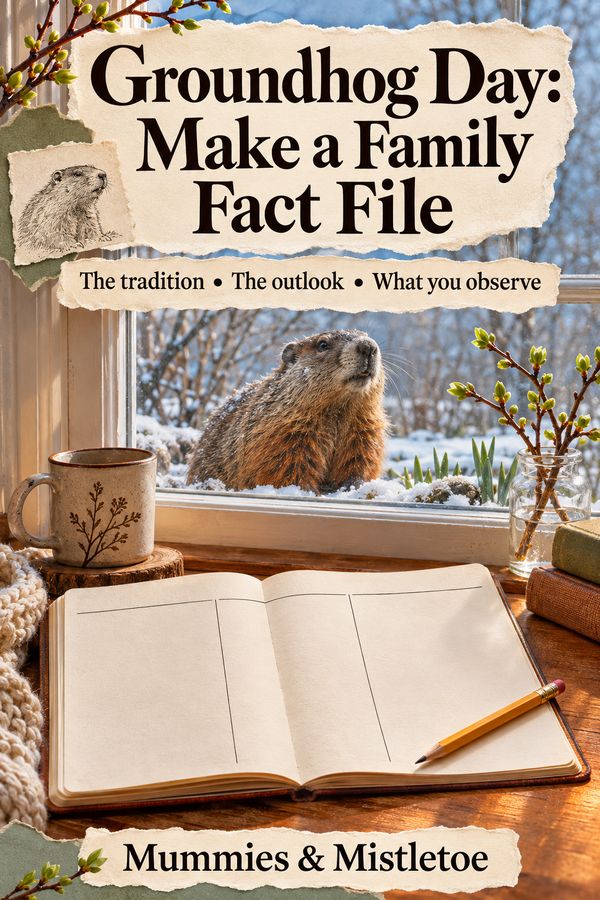
Groundhog Day offers a useful question for curious families: what counts as a prediction, and how would we know whether it was right? Make a small fact file with three sections: the tradition, a scientific outlook and the weather you actually observe.
You can enjoy the ceremony and still investigate the evidence. The interesting part is learning why three statements about “spring” may be talking about three different things.
Record the tradition accurately
Use the National Weather Service’s Groundhog Day history as a starting source. Then find a reliable report of the current year’s announcement. Write down who made the prediction, where the event happened and the exact outcome reported.
Put the year beside it. Search results often show a previous celebration, and a video can look current even when it is several years old.
Ask what “early spring” would mean in your town. Warmer afternoons? Flowers? No more snow? Write those ideas in a separate box. They are your possible definitions, not necessarily the event’s official test.
Read an outlook with its key
Open the Climate Prediction Center’s seasonal outlooks and choose the relevant period. Record the issue date and the months the map covers. Read the map explanation before interpreting the colors.
A seasonal temperature outlook concerns the likelihood of average temperatures falling into categories relative to normal. It is not a promise that every day will be warm or a forecast of the final snowfall. Keep that difference beside your notes.
For younger children, compare the purpose of the two sources in simple terms: one belongs to a yearly tradition; the other uses weather and climate information to describe probabilities. You do not need to turn the activity into a contest between them.
Choose an observation you can repeat
Select a local weather source and record one measurement at a consistent interval, such as the reported daily high once a week. Note the date and location every time. If you also observe a tree, photograph the same branch from the same place.
Avoid changing the test halfway through because a result is surprising. A warm afternoon followed by snow is still part of the record. Write what happened without deciding immediately that it proves or disproves a whole season.
Create four columns: date, weather source, measurement and something noticed outdoors. A single page can hold several weeks without becoming a school-sized project.
Finish with a better question
At the end, compare the three sections. Did your observations cover the same area and time period as the outlook? Did your original definition of spring turn out to be useful? What information would you need for a fairer comparison?
Write a short conclusion that includes uncertainty honestly: “Our tree gained buds while some mornings were still cold.” That is a real finding. The fact file has helped you notice the season more carefully, and next February you will have a much better idea of what to ask.