The magazines are spread across the table, and someone has already cut out a picture of a cabin. Vision board ideas become more useful when there is room for both the lovely picture and the ordinary action behind it. A family evening can give everyone a chance to name what they'd like more of, without requiring matching goals.
Set Out Paper, Pictures and Drawing Supplies
Give each person a sheet of sturdy paper or a small piece of poster board. Put magazines, scrap paper, scissors, glue sticks and drawing tools in the middle. Use tools appropriate for the children joining in and offer help with cutting.
Choose a manageable session length for your family and explain that unfinished boards can be continued later. Each person gets their own space, with a shared sheet for anything the family wants to do together. No one has to fill every inch.
Pictures aren't required. A child can draw a place or activity, and an adult can write a phrase instead of hunting for a photograph. Keep blank paper available so nobody's choices are limited to what happens to be in the magazines.
Before cutting, invite everyone to choose one area they'd like to think about: time together, something to learn, a place to make more comfortable or a habit they'd like to practice.
Divide the Board Into Three Useful Areas
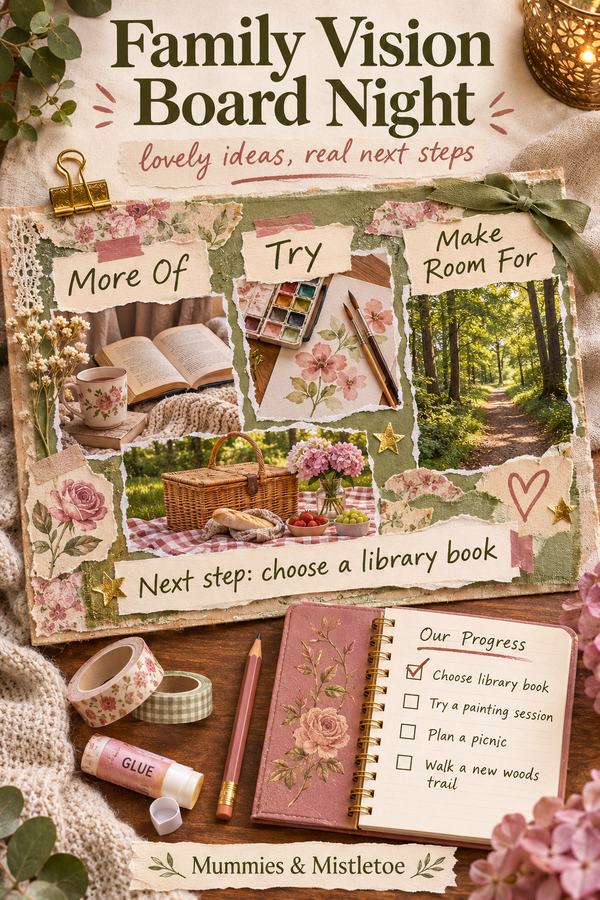
Label three loose areas More Of, Try and Make Room For. More Of can hold things already enjoyed, such as reading together or spending time outside. Try can hold a new skill or activity, while Make Room For can show a change that would help.
A child might put drawing in More Of, riding a bike in Try and a clear art shelf in Make Room For. An adult might choose cooking with friends, learning a few songs and a regular evening without extra commitments. The examples can be modest and specific.
For a looser collage, tuck the three labels among the pictures instead of drawing boxes. Someone might surround Try with bright scraps and leave a quiet corner for Make Room For. The layout can feel as personal as the ideas.
Leave a narrow strip at the bottom for a next step. Keep that space blank until the pictures and words are in place.
Find the Meaning Behind a Picture
Ask each person to explain one picture if they want to. The cabin might mean a holiday, but it might also mean quiet, a fire or time outdoors. The meaning belongs to the person who chose it.
Use a short caption to make that meaning visible. Under the cabin, write 'walk somewhere green together' or 'a quiet reading hour,' depending on what the person wants. A picture of a garden could mean growing one pot of herbs rather than moving to a house with land.
Avoid correcting someone's wish because it seems large. Instead, separate the long-term hope from a small action they can take now. The board can keep the big picture while the next-step strip stays practical.
Sharing is optional. A child can enjoy making the board and keep the meaning of a picture to themselves.
Choose One Shared Plan
Use the shared sheet for an activity people would enjoy together. It could be a picnic, a family cooking afternoon, a walk or a regular game night. Choose one idea to try together first.
Write down what needs to happen for it to work. For a picnic, that might be choosing a nearby place, checking the weather and deciding what to bring. For cooking, it might be choosing a familiar recipe and making a shopping list together.
Give each willing person a small role. A child could choose the blanket or draw an invitation; an adult could handle transport or food preparation. Keep the responsibilities appropriate and make sure someone has agreed to the practical parts.
Add a place to record when you'll revisit the plan. A note that says 'talk about this after our next family supper' is enough to bring it back into the conversation.
Write One Next Step on Each Board
Return to the blank strip at the bottom of each personal board. Choose one action that can begin without waiting for everything else to change. 'Put the drawing supplies in one box' is more usable than 'be more creative.'
For a reading goal, the action might be choosing a book from the library. For learning music, it might be finding a beginner lesson and setting aside a short practice time. For more rest, it might be agreeing on one evening that stays unscheduled.
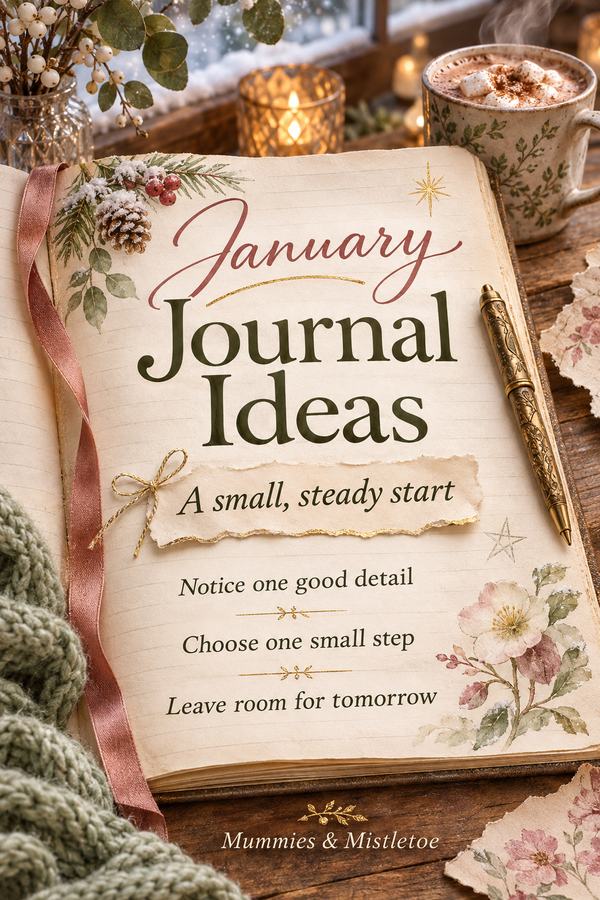
A journal can hold the next steps and what happened afterward. Keep the entry brief: what you tried, what helped and what you'd change. The board supplies the picture; the notebook gives you somewhere to notice real progress.
Let people change the action if they discover it doesn't fit. A useful plan can be adjusted without treating the first version as a failure.
Give the Boards Somewhere to Live
Choose a place for each board where its owner wants it. Some may belong on a bedroom wall or inside a cupboard door; others can stay in a folder. Ask before displaying a personal board where visitors will read it.
Photograph the shared plan so it can be found again even if the paper moves. Put the leftover images and supplies into a folder or box for another session. Slip the next-step notes into the front of the folder, where they'll be easy to find.
Finish by choosing something from the shared board that you can put on the calendar. The collage can stay full of possibilities while one small plan, a library trip or a cooking afternoon, becomes part of the coming week.
For someone who wants a separate place to record those small experiments, the Owl and Roses journal offers lined pages for the steps after the collage. Start with the outing or activity you've actually chosen, then leave room for what happened.