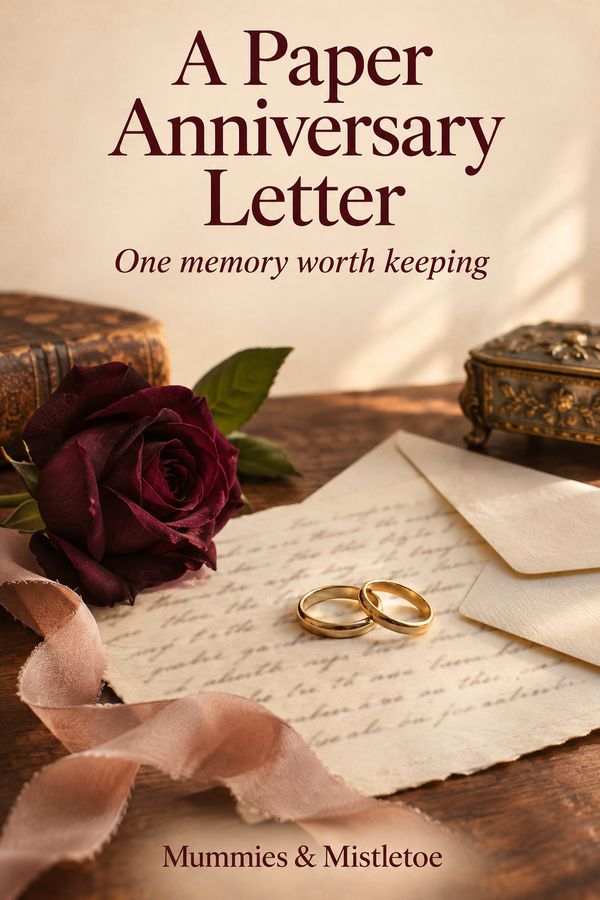
One remembered afternoon can say more than a page of enormous promises. For a paper anniversary letter, choose a scene from your life together and give it the space it deserves.
You do not need to summarize the relationship. You need to help the person you love recognize a moment you both lived, and understand why it mattered to you.
Choose a small scene with something inside it
Look for an ordinary moment that reveals a quality you value. Perhaps they made you laugh during a difficult move, remembered how you take your tea, or sat beside you when there was nothing helpful to say.
Avoid choosing the most impressive event simply because it sounds worthy of an anniversary. The memory that returns while you wash the dishes may be the better one.
Write a few private notes first: where you were, what you noticed, what they did, and what changed for you. If your recollections differ, write from your perspective rather than declaring the official version of the day.
Give the letter a simple shape
Use four short movements:
1. Bring them into the scene.
2. Describe the thing they did or said.
3. Explain what you understood or felt.
4. Connect that memory to a hope for your next year together.
You might begin, “I keep thinking about the evening we ate takeout on the floor because the table was still in the moving truck.” Then stay with that evening long enough to make it real.
Details help: the cardboard box used as a table, the terrible joke, the way they made an unfamiliar room feel like yours. You need only two or three. A letter is not a transcript.
Say what the memory means
After the scene, name the quality you are thanking them for. “You made room for us to be happy before everything was finished” is more personal than “You are amazing.”
Keep the praise believable. Nobody is patient every minute or always knows exactly what to do. You can appreciate a real person without polishing them into a fictional one.
If the year was hard, the letter does not have to pretend otherwise. You can write about one moment of companionship that mattered without using an anniversary card to reopen an unresolved argument.
End with a hope you can share
Choose something reachable: more unhurried breakfasts, another visit to a place you love, or making time for a weekly walk. Phrase it as an invitation, not a contract slipped into a love letter.
For example: “I hope we give ourselves more evenings like that, when we stop fixing everything long enough to enjoy being here.” Use your own words, even if they are plainer. Especially if they are plainer.
Present it without turning it into a performance
Handwrite the letter if you enjoy it, or type it in a readable size. Add the date and your name. A folded sheet in an envelope is already a complete gift.
Give it privately and let your partner read at their own pace. They do not owe you an equally polished response on the spot. If you both enjoy the idea, you can keep anniversary letters together and add another next year.
Slip the letter into its envelope with the date on the back. The next time you find it together, that ordinary afternoon will be waiting inside.