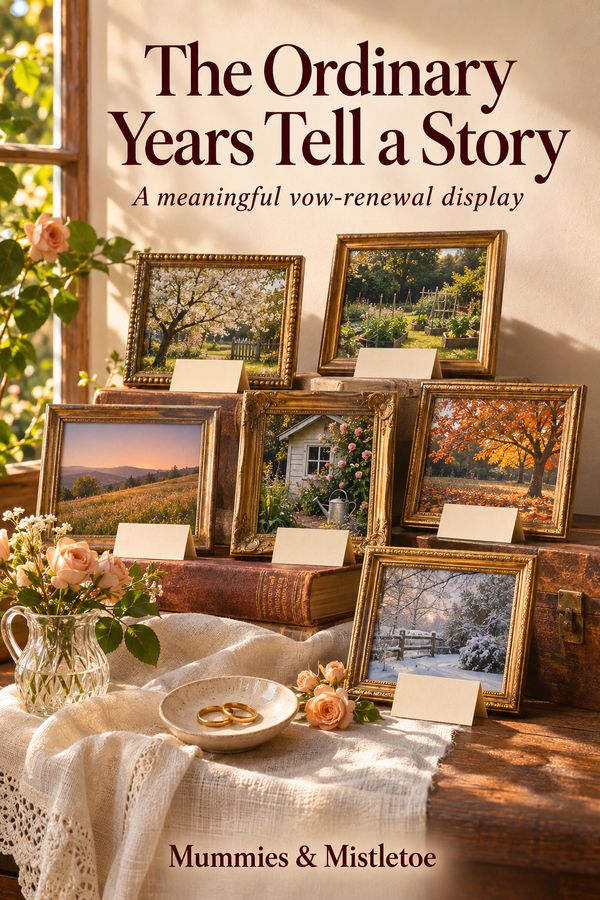
The wedding photograph tells how a marriage began. A vow-renewal display can tell what happened after: the rented kitchen, the unfinished garden, the family joke, the ordinary place that became home.
Choose a handful of moments that show a life being built, not only the milestones that looked impressive in photographs.
Agree on the story you want to share
The couple should choose the tone and boundaries together. A public display is not the place for one partner to reveal a difficult chapter the other expected to keep private.
Ask, “What would we like guests to understand about our years together?” The answer may be humor, persistence, shared interests, family, friendship, or the pleasure of ordinary days.
You do not need an image for every year. Six thoughtful entries can be more engaging than a timeline so crowded nobody reads it.
Look beyond the formal photographs
Search for moments with a specific story: the first meal in a new home, a much-loved pet, a regular walking route, a hobby learned together, or a celebration that went cheerfully wrong.
If no photograph exists, use a copy of a recipe, a simple drawing of a place, or a short written memory. Avoid placing irreplaceable originals where food, drink, or handling could damage them.
Ask permission before featuring other people prominently, especially children. A family photograph can hold private information or a memory someone would rather not display.
Write captions that reveal something new
A useful caption has three pieces: an approximate date if known, what is happening, and why it matters. For example: “Our first summer garden. We grew far too many beans and learned that we both enjoy an ambitious plan more than we enjoy weeding.”
Keep the tone affectionate and shared. Humor should not depend on humiliating one partner or exposing a private argument.
If you disagree about a detail, acknowledge the uncertainty lightly or leave the exact detail out. A display does not need a false precision that neither person can confirm.
Arrange by meaning, not only by year
Consider small groups such as “Places We Made Home,” “Things We Learned,” and “Ordinary Joys.” These can tell a richer story than a strict sequence of dates.
Use large enough captions to read comfortably and leave space between entries. Keep the display away from the main food queue so guests can pause without blocking others.
A tabletop version may be easier to manage than a wall installation. Choose stable supports and a location where people can view it without reaching across fragile objects.
Add one invitation to respond
Place a few cards nearby with a gentle prompt: “A moment with us you remember fondly.” Guests can contribute if they wish, and the couple can read the cards later.
Do not require everyone to tell a story aloud. Some people will enjoy looking quietly, and that is participation too.
After the celebration, save the captions with the photograph copies. The written context may become the most valuable part of the display over time.
A vow renewal looks toward the years ahead. Showing the ordinary years already lived gives those promises a setting: not an idealized marriage, but a real shared life with details worth remembering.