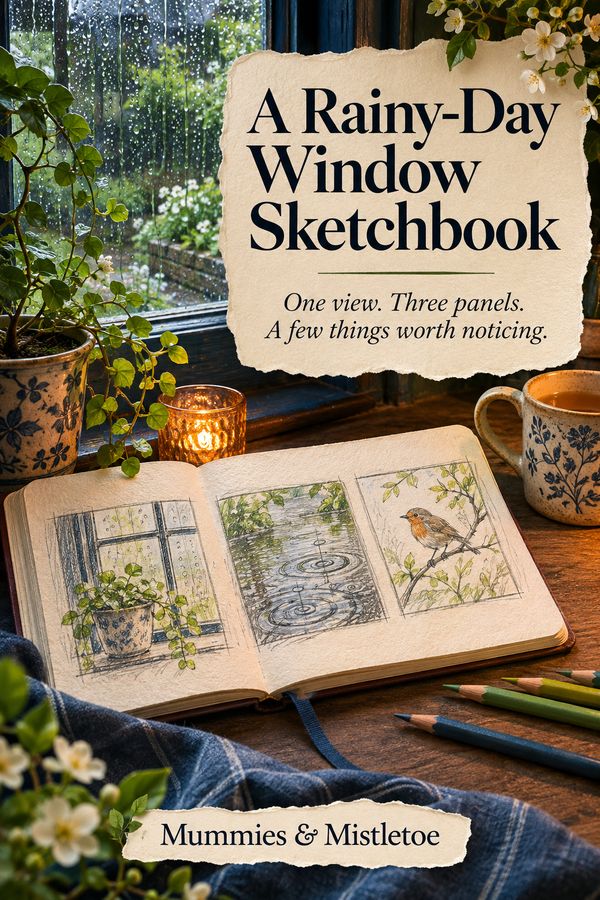
Rain on the window gives you a changing subject that stays conveniently close to a chair. A spring window sketchbook can begin with a pencil, ordinary paper and ten minutes of looking. You do not need to draw a convincing landscape to notice something worth keeping.
Choose one window you can return to. The repeated view is what makes the pages interesting as spring develops.
Divide the first page into three spaces
Use one space for the whole view, one for a close detail and one for words. Draw lightly so you can change your mind. A tree may be only a branching line, and a building can be a rectangle.
In the detail space, choose something small: a droplet, a leaf bud, a bird on a fence or the shape of a puddle. In the words space, write the date, approximate time and two things you noticed. “Wind moving the top branches; pavement darker near the gate” is useful observation.
Give yourself a different question each visit
Try one of these prompts:
- Where is the lightest part of the view?
- Which lines are straight, and which bend?
- What moved during the last minute?
- What looks different because it is wet?
- What has appeared since the previous page?
Use the question to guide looking, not to grade the drawing. If something moves before you can sketch it, draw the place it was and write a sentence about it.
Add color only if you want it
A few colored pencils can show changing greens or gray-blue reflections. Choose three colors and see how much you can describe with them. Keep water and art supplies away from electrical items and protect the surface you are using.
A plain notebook works. If a dedicated journal helps you return to the habit, browse Mummies & Mistletoe for a cover you would enjoy keeping nearby. Check the paper against the materials you plan to use; lined writing paper and wet paint have different needs.
Make room for company
With a child or friend, look at the same view for a minute before talking. Then compare what each person noticed. One might draw the rain while another notices the empty chair across the street.
Keep the activity away from identifying or recording neighbors' private routines. You are observing the view, not documenting people through their windows.
Return on a dry day and make the same three-part page. By the end of spring, the notebook will hold a small record of light, weather and attention from one ordinary place.