Take the Stems Out of the Tight Bunch
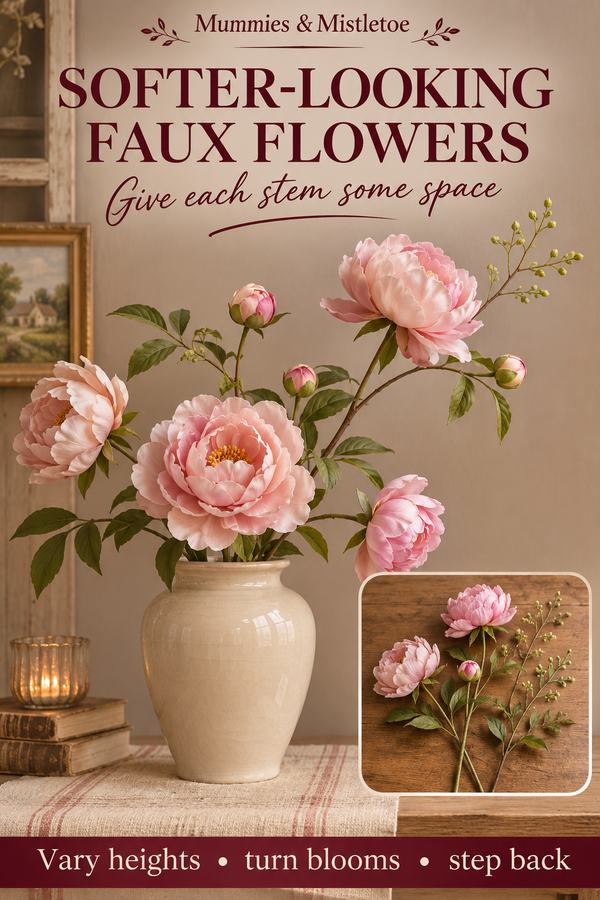
A faux bouquet usually looks more natural once the stems stop behaving like a packaged bunch. Give the large blooms different heights, let small branches break the outline and leave a little air between them. You can try all three changes with flowers you already own.
Begin with one vase and five larger flower stems, such as faux peonies, plus two smaller branching stems. This is an arrangement plan, not a requirement to buy that exact combination. You can practice with a bunch you already own and decide which parts are worth keeping.
Look at the Parts People Will See
Examine one bloom closely before buying several. Look for a center that holds its shape, petals with some variation and seams or glue that don't dominate the visible side. Turn it around, because the back may face a guest when the vase sits on a table.
Check the leaves as carefully as the flowers. A good-looking bloom can be let down by a leaf that appears flat, shiny or identical to every other leaf. Compare the stem with a photograph of the real flower to judge its overall shape, while allowing for the simplified construction of an artificial stem.
Hold the stem away from your face as well as close up. A little detail that disappears from a normal viewing distance may not matter in the place you plan to display it. Choose for that actual setting rather than expecting one stem to work equally well in every close-up.
Choose the Vase Before Cutting Anything
For a sample arrangement, use an opaque vase about seven inches tall with an opening around four inches across. Aim initially for an overall height near fourteen inches, including the vase, then adjust to the shelf or table where it will stand. Use these measurements as a starting point and adjust to your flowers.
An opaque vase hides the construction below the rim. It also lets you test folded stems or a removable support inside without making those parts visible. Check that the vase is stable with the stems arranged toward one side as well as upright.
Keep the stems long during the first arrangement. If their construction allows bending, fold the lower portion within the vase instead of cutting immediately. When cutting wired stems is necessary, use the appropriate tool and finish the ends so they cannot scratch the vessel or your hands.
Build the Arrangement in Layers
Place one large bloom slightly above the center and angle it a little away from the viewer. Add two blooms lower down, one to each side, then place the remaining two nearer the front at different heights. Avoid lining up all five faces along the same horizontal line.
Add one branching stem toward the back and the other nearer a side. Place the smaller shapes unevenly around the larger flowers to soften the outline. Leave a few spaces where the background can be seen between stems.
Turn the vase a quarter turn and look again. If it will stand against a wall, concentrate the fullest view toward the room while keeping the sides tidy. If people will see it from all directions, repeat the checking process around the entire vase.
Shape the Stems Without Forcing Them
Follow the maker's guidance for bending or shaping. Some artificial stems are flexible and others are not, so test gently before making a large change. A slight curve below a bloom can soften the upright position without requiring a dramatic bend.
Rotate one flower so its face points sideways, then lower another just below the vase's main cluster. These small differences can do more than adding another stem. If every flower still looks identical, remove one and let the remaining blooms have more space.
Adjust leaves individually where their construction allows it. Let one turn outward and another sit partly behind a flower. Don't bend brittle parts or use heat unless the manufacturer specifically provides a safe method for that material.
Use the Room to Judge the Arrangement
Put the vase in its intended place and view it from the doorway, the nearest chair and standing beside it. A tall arrangement may work on an entry table but interrupt conversation on a dining table. Move the vase before rebuilding the flowers if the location is the problem.
Choose the background as part of the display. Pale flowers may show more shape against a darker wall, while a patterned backdrop can make a detailed bouquet hard to read. A plain runner under the vase can connect it to a table without adding more competing objects.
Take a photograph from the usual viewing point. Look for the one thing that feels stiff: repeated heights, a visible stem joint or a flower pointing straight at the ceiling. Correct that single issue before buying extra filler.
Keep the Arrangement Ready for Another Season
Follow the care instructions for dusting and cleaning the materials. Don't assume the petals can be washed, sprayed or placed outdoors. Keep the packaging or care label with your stored stems so the next arrangement starts with the same information.
Photograph the finished shape before taking it apart, then store the stems without crushing the flower heads. A removable ribbon on the vase or a different table textile can change the seasonal setting while the flowers stay the same. Keep the arrangement photo with the stem labels so you can recreate the shape or change just one part next season.
For an autumn version of the same arrangement, choose the textile before changing the flowers. The runners and tablecloths in our Thanksgiving collection offer a palette to borrow for a ribbon or a few stems you already own.