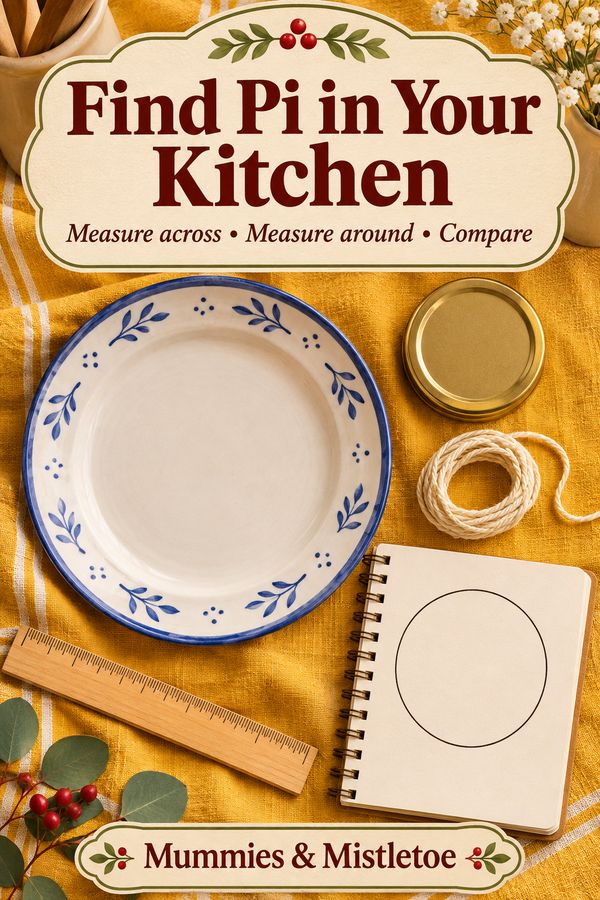
How many times does the distance across a round plate fit around its edge? For Pi Day, answer with a piece of string, a ruler and a few circular objects from the kitchen. The result is a useful little experiment, including the imperfect measurements.
You need three objects with clearly circular edges, such as a plate, a jar lid and a round container. Avoid sharp rims, fragile objects and anything too heavy for the children taking part.
Make a prediction first
Ask everyone to estimate the answer before measuring. Will the distance around be twice the distance across? Four times? Write the guesses without correcting them yet.
Explain two words: diameter is the straight distance across a circle through its center; circumference is the distance around it. Draw a circle and mark both so the measurements have a clear meaning.
Use the same units throughout. Centimeters are convenient because the calculations stay simple, but inches work too if everyone records them consistently.
Measure across the center
Place the ruler across the widest part of the circular edge. Keep it straight and aim through the center. Record the diameter, including the unit.
Try the measurement again from a different direction. A true circle should give the same diameter, allowing for small measuring errors. If the numbers differ a lot, check whether the object is actually oval or whether the ruler missed the center.
For a plate with a raised rim, choose one edge and use that same edge for the measurement around it. Mixing an inner diameter with an outer circumference will confuse the result.
Measure around the edge
Wrap nonstretchy string once around the chosen circle, mark where the ends meet and straighten it along the ruler. Keep the string snug without pulling it tight enough to stretch.
Record the circumference. Divide that number by the diameter with a calculator. For example, a measured circumference of 31.5 centimeters and diameter of 10 centimeters gives 3.15.
Repeat with the other objects. Make a table with object, diameter, circumference and the result of the division. Most careful measurements should land near 3.14, an approximation of pi.
Use the errors as clues
If one result is far away, investigate. Did the string slip? Was the diameter measured off-center? Did someone switch units? Measure again and keep both results so you can see what changed.
Explain that pi is the same ratio for every circle, but your household measurements are approximate. The point is not to make every answer exactly 3.14 by adjusting the numbers.
Finish with one practical question
Ask how much ribbon would be needed to go around a circular container with a known diameter. Multiply the diameter by approximately 3.14, then compare the estimate with a direct measurement. Add any extra length needed for the actual wrapping separately.
Keep the table with a photograph of the objects. Pi Day has given you more than a themed dessert: you have found a relationship hiding in ordinary kitchen things and tested it with your own hands.