Someone has drawn a tiny ghost beside their name. Another guest has invented a suspiciously elaborate title for your house. By the end of the evening, a few lined pages can hold the small jokes you would otherwise forget.
A Halloween guest book gives friends something easy to add while they visit. Open a journal, put one playful prompt at the top of the page and let the answers gather through the party. You can use the same book for a Halloween supper, an autumn open house or a quiet gathering with a few friends.
Choose the First Page of Your Halloween Guest Book
A lined journal is a useful place to begin because the page already gives people somewhere to write. Our Halloween Goose journal has 150 lined pages and a matte cover, with enough room to keep the party notes together across several gatherings.
On the first page, write a short welcome in your own handwriting. Try: “A record of the curious people who came through this door.” Beneath it, add the names of the hosts or a nickname for the house.
Turn to the next spread and choose the first prompt before guests arrive. Leaving the entire book blank makes people wonder what you want them to do. One sentence at the top gives them a way in.
Offer a Quick Signing Page
For a busy gathering, begin with three short lines for each person: name, “Arrived as,” and “Brought along.” Leave a little space between entries so the page stays easy to follow.
“Arrived as” can be a costume, a description or a joke. Someone wearing regular clothes might write “the person who followed the smell of cookies.” “Brought along” can mean the friend beside them, an actual dish or an imaginary companion.
Write your own entry first. For example: “Mara / Keeper of the snack table / A suspicious amount of cheese.” A playful example makes the page feel like part of the party.
Guests can use only the name line if that's what they feel like adding. The next page gives anyone who enjoys writing a little more to do.
Let Guests Invent the House Story
On a separate page, write “If this house were in a Halloween story, what would it be called?” Leave the rest of the page for titles. You might get “The Cottage of the Missing Spoons” beside “A Very Polite Haunting.”
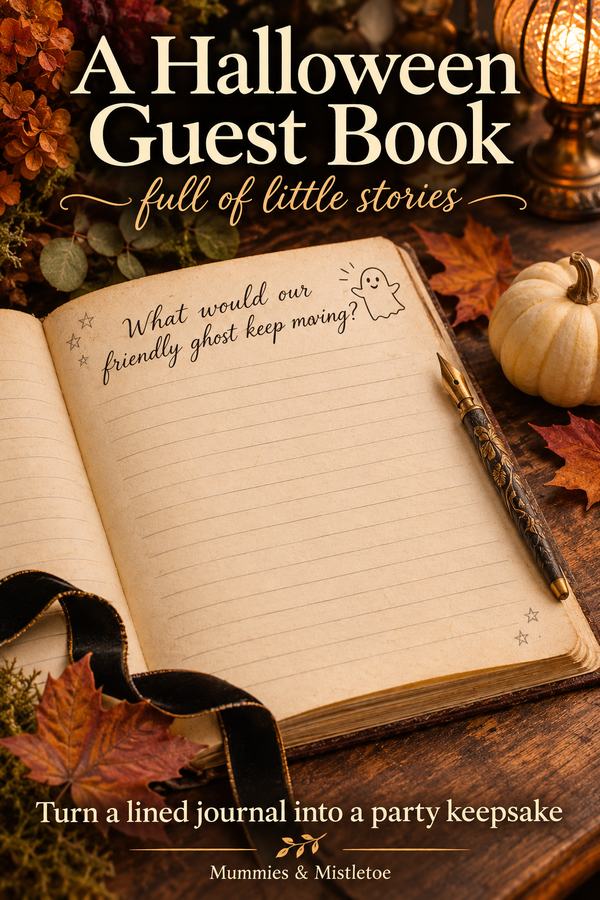
At a smaller gathering, try a second prompt: “What would the friendly ghost keep moving?” The answers may be as ordinary as the remote control, the good scissors or the last chocolate cookie.
These prompts work especially well when people already know the house. A familiar creaking stair or a stubborn kitchen drawer can become part of the story. Let guests add little drawings in the margins if they like.
Later in the evening, read a few of the invented titles aloud. Someone will probably have a reason for their answer, and that can be the beginning of another conversation.
Make a Page for the Evening's Favorites
A few short questions can catch the things people noticed while they were there. Use one prompt per page, with room for several answers underneath.
Try “The snack I'd come back for,” “The detail I noticed first,” or “The moment that made me laugh.” At a costume gathering, “One clever costume detail” invites people to appreciate the little work someone put in.
Avoid turning the page into a ranking of guests. The book is more fun when it gathers details: a handmade button, the tiny pumpkin on a hat, the way somebody introduced their character. You might learn that the part you barely noticed was someone else's favorite.
For a gathering without costumes, use “Something that belongs in our next autumn evening.” Answers might include a particular board game, a shared song or another plate of the same cookies.
Give Children a Different Way to Join
Set aside a spread for drawings with the heading “Our Friendly Monsters.” A child can draw a creature, add its name and tell you one thing it likes to eat. A monster that eats broccoli or misplaced socks can sit happily beside the grown-ups' messages.
Write down a younger child's explanation in the words they use. “He only scares pumpkins” is worth keeping exactly as it was said. An older child may want a whole page for the creature's habits and unusual home.
Ordinary pencils make a simple choice for this page. Keep a spare piece of paper beneath it if anyone presses hard, and offer loose paper for children who want to make a larger picture to take home.
Let the Book Travel Through the Party
Begin with the journal on a small table where people can sit down to write. Put a working pen beside the open page and mention it once as guests settle in. It can move to the dinner table or sofa later, when people are talking.
For a supper with six friends, pass it around while you're finishing dessert. For a busier open house, leave it in one comfortable spot and let people find their own moment. You can turn to a different prompt halfway through the evening to give returning visitors something new to read.
After everyone has gone, add one memory in the space below the final answer. Perhaps it's the joke from the kitchen or the friend who stayed to help with dishes. The quiet house will have its own last line.