Measure your table in the arrangement you will actually use, with any extra leaves in place. This tablecloth size guide shows how to turn those dimensions into a cloth size and check the drop beside each chair.
Keep a tape measure, pencil and scrap of paper beside you. You'll calculate the fabric beyond the edge, usually called the drop, then check that amount against the chairs and the way you serve. The right choice is one that fits both the tabletop and the meal.
Start This Tablecloth Size Guide With Three Notes
Write down the table's shape, its top dimensions and whether those dimensions include extensions. For a rectangle, measure the long side and short side. For a round table, measure straight across the center from one edge to the other.
For an oval, record the full length and the widest point across the center. Note whether the ends are broadly curved or more pointed. Those details matter when you compare the shape of the cloth, even if the length and width seem close.
Measure the actual table instead of using its advertised seat count. Two tables that both seat six may need different cloths. If you regularly use the table both extended and closed, record both sets of measurements so you can see whether one cloth can serve both arrangements.
Calculate a Rectangular Table's Drop
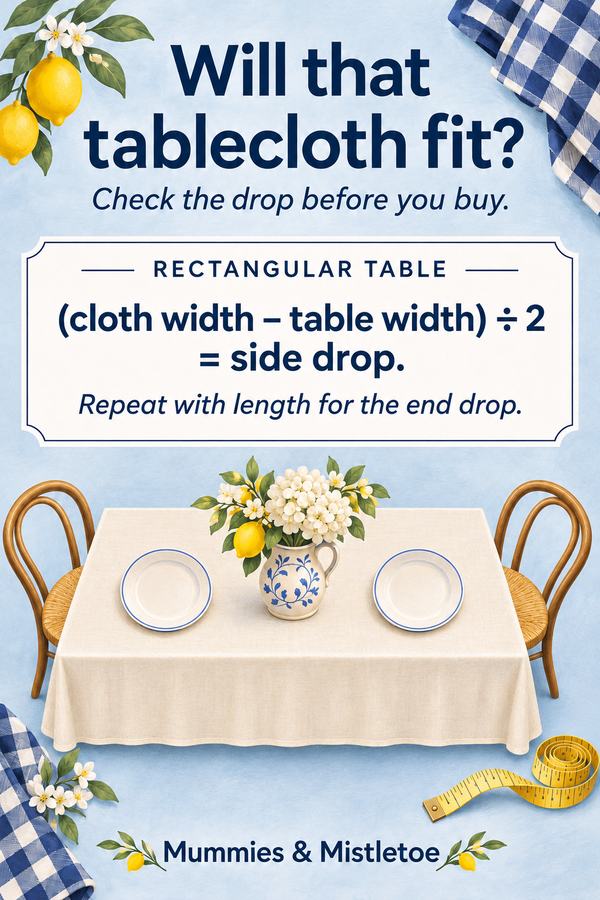
Subtract the table's width from the cloth's width and divide by two. Do the same calculation for length. Those results tell you the side drop and end drop when the cloth is centered.
For a table that is 36 inches wide and 60 inches long, a cloth measuring 60 by 84 inches gives a 12-inch drop on all four sides. The width calculation is 60 minus 36, divided by two. The length calculation is 84 minus 60, divided by two.
A 60-by-90-inch cloth on that same table still gives a 12-inch side drop, but the ends hang 15 inches. That difference may suit the table, or it may put more fabric against the end chairs than you want. Check each direction rather than assuming a cloth has one uniform drop.
Measure Round and Oval Tables
For a round table with a round cloth, subtract the table's diameter from the cloth's diameter and divide by two. A 70-inch round cloth on a 48-inch round table gives an 11-inch drop around the edge. Use a measuring tape hanging from the edge to see where that length finishes.
For an oval table, compare both the length and the width of an oval cloth. You can calculate the drop at the ends and at the widest side points using the same subtraction-and-halving method. The drop between those points also depends on how the two curves match.
A rectangular cloth over an oval table will hang differently around the corners and curves. If you like that look, test it with a cloth or sheet you already own before buying. Dimensions alone won't show the entire outline of the hanging fabric.
Check the Extended Table Before Buying
An extension changes the end drop when you keep using the same cloth. Suppose your 36-by-60-inch table opens to 36 by 78 inches. A 60-by-84-inch cloth then has a 12-inch side drop but only 3 inches at each end.
You may be happy with that shorter end drop for an everyday family meal. For a more evenly hanging cloth, compare a longer option. A 60-by-102-inch cloth on the extended table gives 12 inches at the sides and 12 inches at the ends.
Write the extended size beside the closed size in your notes. If the two arrangements need separate cloths, label each one with the table setup it fits. That makes it easier to find the correct cloth when the extra chairs are already on their way.
Test the Drop With the Chairs in Place
Choose a proposed drop and hold a measuring tape or scrap of fabric over the edge to that length. Pull a chair in, sit down and stand up again. Check whether the fabric catches on knees, arms or the seat.
Repeat the test at the ends and along a bench if you use one. An attractive long drop may be awkward where people slide along a seat. For a serving table, check cabinet doors, nearby walking space and anything stored underneath before letting fabric hang low.
Look at the tabletop as well. The cloth should lie smoothly enough for glasses and plates to sit steadily. Follow the textile's actual care directions for any pressing, and choose a different arrangement if a thick fold creates a ridge under a place setting.
Compare Size, Fabric and Care Together
Take your measurements to the listing and check the exact option selected. Read any stated size variation and material information. A photograph of a cloth on a styled table can't tell you how it will fit your own surface.
Think about how often the cloth will be used and what its care routine involves. A regularly used family table may call for a different fabric choice from an occasional display table. Check the maker's washing and drying instructions for the exact cloth.
Save the chosen cloth dimensions with the table measurements and the drop you calculated. When it arrives, lay it out and repeat the chair test before building the centerpiece. Fold the measurement note into your linen-storage record so the next gathering starts with a size you already know.
For a square seasonal option, our blue pumpkin tablecloth measures 55.1 inches on each side. Compare that actual size with your tabletop and chair test before choosing it for an autumn meal.