Before putting holiday mugs away, give each one a clean, dry, cushioned place in the box. Follow its own care instructions and leave the handle free of weight from neighboring cups. A few minutes now will make unpacking the next season much nicer.
A printed ceramic mug, a hand-decorated cup and an older collectible may need different treatment. Keep the instructions for each piece rather than treating the whole shelf as one matching set. A small care note in the storage box can save a search when the mugs come out again.
Make a Care Record While the Details Are Available
Keep the product card or save the listing information when a mug arrives. Record whether the maker permits a dishwasher or microwave and whether there are particular cleaning instructions. If the mug is a gift, ask the giver for the product details when you need them.
Don't infer care from the color of the decoration. A gold-colored printed design isn't necessarily metallic, while an actual metallic finish may have different restrictions. The maker's description should identify the decoration and how the finished item can be used.
For a mixed collection, put a short note with each mug or keep a list with a small identifying photograph. That is useful when several cups look similar but come from different makers.
Follow Holiday Mug Care for the Specific Product
Our Christmas Nutcracker Mug with the coordinated raspberry, jade and gold soldier trio is an 11-ounce white ceramic mug with flat printed artwork. Its listing states that it is microwave and dishwasher safe and can be washed by hand with warm water and dish soap. Those instructions apply to that product, not automatically to every cup in a holiday collection.
If you wash a mug by hand, use the cleaning method the maker recommends and rinse it well. Avoid trying an abrasive pad, strong cleaner or stain-removal trick without checking whether it is suitable for the surface. A method used on an undecorated cup may not suit another finish.
For dishwasher use, follow both the mug's instructions and the appliance's loading guidance. Place it so it is supported and won't knock against neighboring items during the cycle. Don't wedge the handle where unloading another dish will pull against it.
Check the Cup as You Put It Away
Look at the rim, handle and base after washing. If you find a crack, a loose handle or a sharp chipped edge, take the mug out of drink service and seek advice about the damage. Don't assume a household repair makes it suitable for hot drinks again.
For an older cup with unknown use or care information, check with a knowledgeable source before using it for food or drink. It can remain a display piece while you investigate. Its age or appearance alone doesn't tell you how it should be used.
If a recently purchased mug arrives damaged, keep the order information and photograph the problem before contacting the seller. Keep the packaging until you have checked the seller's process. That gives them the details needed to help.
Give Everyday Holiday Mugs an Easy Place to Live
If you use a favorite holiday mug throughout the year, put it where you can reach it without lifting a stack. A front-facing position on a stable shelf lets you enjoy the design and makes the cup easy to pick up. Keep the handle clear of the shelf edge.
Use a rack only if it is intended for the cups you are hanging and is securely installed according to its instructions. Check that the handle fits without being forced onto the hook. A decorative rack may not suit every mug shape.
Group the cups you use most often near the drinks area, with less-used pieces elsewhere. Leave enough space to take out one cup without brushing the next. The shelf should work when you're reaching for it before breakfast.
Pack Seasonal Cups One at a Time
Let mugs dry fully before packing them. Wrap each separately in clean protective material and cushion the base, rim and handle without forcing material through a narrow handle opening. A divided box can help keep pieces apart if its compartments fit the actual mugs.
Place the cups so they don't move into one another when the box is carried. Fill empty spaces with suitable cushioning. Keep heavy items out of the same box unless the packaging supports them separately.
Test the box by lifting it gently before closing it. If you hear movement, open it and adjust the packing. Label it with its contents and keep it in a stable, dry place where heavier boxes won't be piled onto the cups.
Keep the Care Note With the Collection
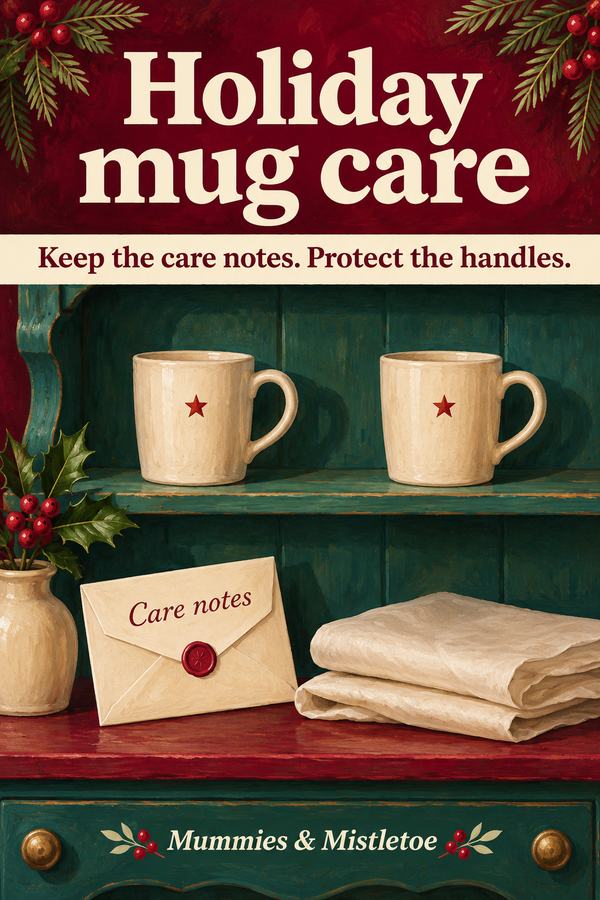
Put the product cards or your care list in an envelope near the top of the box. Add a note if a piece is for display only or waiting for advice about damage. That stops someone from unpacking it straight into the kitchen cupboard without knowing its history.
A photograph of the packed arrangement can help when you put the collection away again. It also makes it easier to notice that a cup is still in use elsewhere in the house. Update the list when you add or retire a piece.
When the next season arrives, unpack onto a clear surface and check each mug before washing it for use. Set the first clean cup beside the kettle, with its handle turned where your hand naturally reaches.