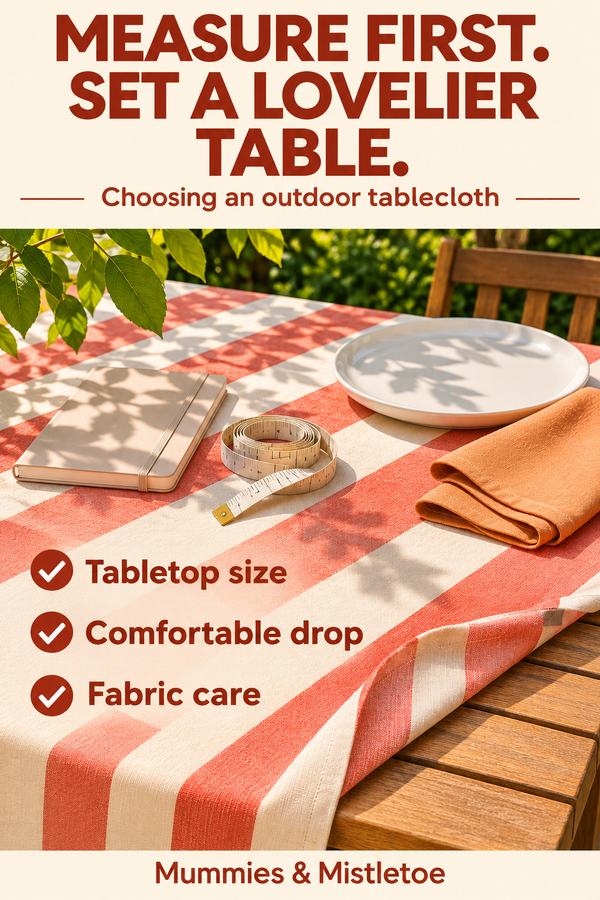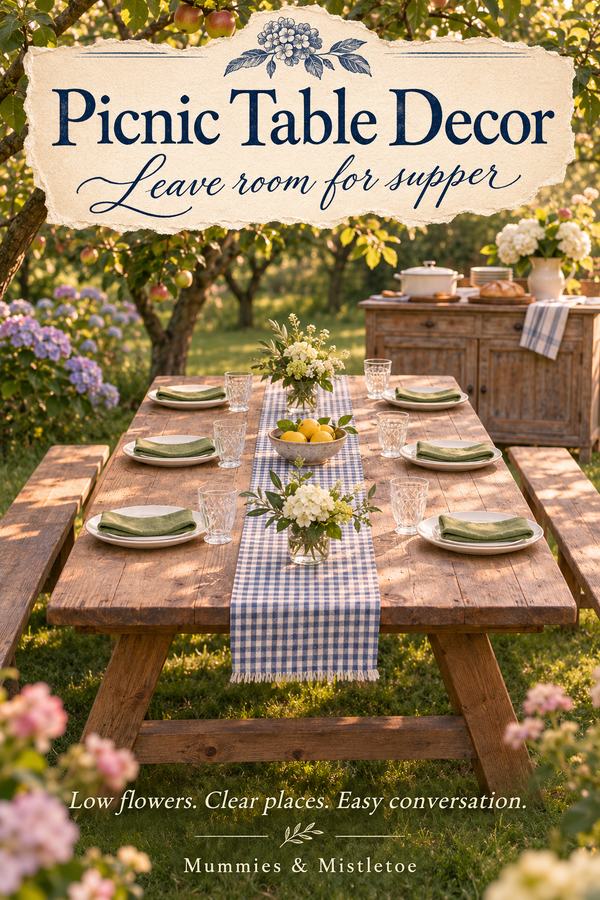
For an outdoor tablecloth, fit and movement matter as much as pattern. Check the drop beside benches, choose a fabric you can care for and plan how to secure the corners. A cloth that stays clear of feet and plates will make the meal more comfortable.
Measure the tabletop before you fall for a pattern. Then choose the drop, fabric and fastening method as one decision. A cloth that looks right in a photograph can behave quite differently once eight people are moving around it.
Measure the Tabletop, Not the Whole Picnic Table
For a rectangle, measure the top from end to end and from side to side. Leave attached benches out of the measurement. Note rounded corners, an umbrella opening, and any slats or edge trim that might affect a clip.
For a round table, measure straight across the center to find the diameter. For an oval, measure the longest and widest points, then look for an oval cloth if you want a more even drop around the curved ends.
Write the measurements in your phone or notebook. Add the tabletop thickness if you plan to buy clips, since a clip that fits a thin folding table may not open far enough for a thick wooden edge.
Choose a Drop That Works With the Seats
The drop is the fabric hanging beyond the tabletop. A shorter drop is often easier around picnic benches; a longer one can suit separate dining chairs in a sheltered spot. Choose the length that lets everyone sit down and get up comfortably.
Test your proposed drop with a dish towel or a strip of paper. Hang it over the table edge and ask someone to sit, stand and move along the bench. Check the ends too, where people may step over a bench or lift a child into place.
For a rectangular cloth, add twice the chosen drop to both tabletop dimensions. For a round cloth, add twice the drop to the tabletop diameter. Use those dimensions to compare available sizes, allowing for any shrinkage noted in the care information.
Work Through the Size Before Ordering
Here are three examples using an illustrative 6-inch drop:
A 30-by-60-inch rectangular top needs a cloth about 42 by 72 inches.
A 36-by-72-inch rectangular top needs a cloth about 48 by 84 inches.
A 48-inch round top needs a cloth about 60 inches across.
If the available size is different, calculate the actual drop. A 60-by-84-inch cloth on that 36-by-72-inch table hangs 12 inches at each side but only 6 inches at each end. That may be fine with chairs, but it deserves a bench test before you order.
For a 52-by-70-inch cloth on a 30-by-60-inch table, the drops would be 11 inches at the sides and 5 inches at the ends. Reading both numbers is more useful than relying on a listing's general seating estimate.
Choose an Outdoor Tablecloth for the Meal You Serve
For a garden lunch, a washable woven cloth gives napkins and plates a soft background. Cotton, linen and blends can have different care needs and shrinkage behavior, so compare the care information on the actual product rather than treating the fiber name as a promise.
For repeated family meals, a wipe-clean surface may be easier between plates of fruit and sticky hands. Check whether the manufacturer permits folding, machine washing or only wiping; similar-looking coatings can need different handling.
For a party where the cloth will be washed afterward, look for instructions you can follow at home. A large cloth that won't fit your washing setup creates another task after guests leave.
Water-resistant and waterproof describe different things, and neither tells you that a cloth can remain outdoors indefinitely. Choose according to the stated use and care details, including whether sun exposure or damp storage is addressed.
Plan for Wind Before the Plates Arrive
Choose clips that fit the tabletop thickness and can grip without damaging the finish. Place them where guests won't scrape a hand or catch clothing. Try the cloth and clips together while the table is empty so you can see whether fabric still billows between them.
Hanging corner weights can suit some cloths, but they won't solve every windy-table problem. Consider how close they hang to knees and whether they can strike the table legs. A short drop or a fitted cloth may make more sense at a frequently breezy spot.
Avoid using drinking glasses, serving dishes or candles as improvised anchors. If the wind is strong enough to keep lifting the table covering, move the meal to shelter or leave the tabletop bare and use washable place settings.
Make Room for the Umbrella
An existing umbrella complicates the order of setup. Check whether the cloth has a center opening and whether it also has a slit or fastening that lets it wrap around the pole.
A center hole alone may still require lifting the umbrella out first. Before buying, picture who will set the table and whether removing the umbrella is practical. Check that the cloth's fastening won't leave a bulky ridge beneath a plate.
If you prefer an uncut cloth, an umbrella-free table nearby can hold the food while the shaded table uses individual placemats. That arrangement also keeps serving dishes from crowding the space around the pole.
Let the Pattern Help the Table
Choose the cloth with the plates you actually own in mind. A small print can bring color to plain white dishes, while a broader stripe gives a simple direction to a long table. For patterned dishes, pull one quieter color from the rim into the cloth.
Photograph the sample beside a plate in daylight if you have one. Keep the chair cushions and flowers in the picture too. That makes it easier to spot a color that looks right alone but fights everything around it.
After the meal, brush off crumbs and follow the care instructions before storing the cloth completely dry. Keep the clips in a small pouch with it, so the next outdoor lunch starts with the right pieces together.
For an autumn meal on a small square table, our Blue Pumpkin tablecloth is one option to measure against your plan: it is 55.1 inches square. Work out the drop on your own table first, and bring it in for care and storage after the meal.