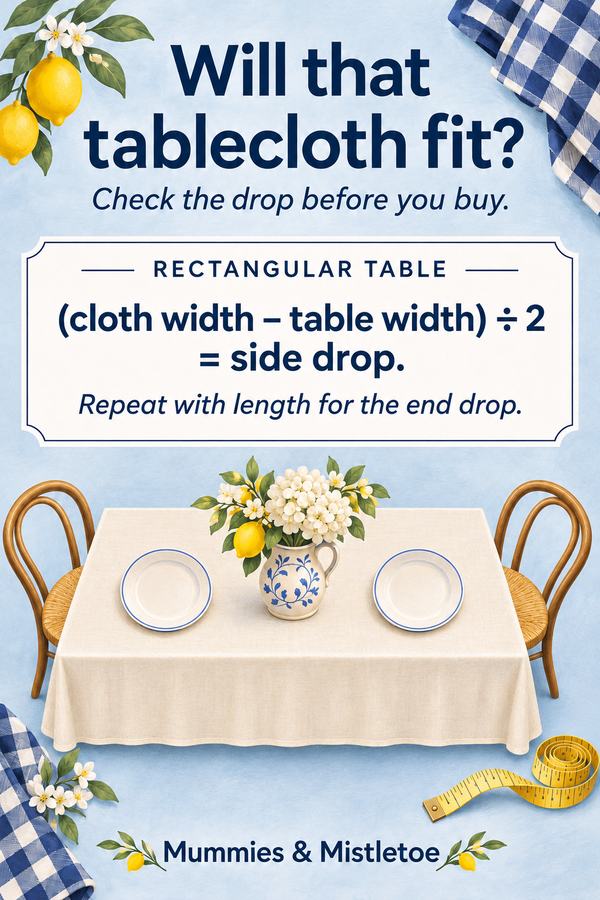
A table runner needs two measurements and one design decision: should the ends hang over the table or stay entirely on top? Start there, and you can choose a length that fits both the surface and the way you serve meals.
Measure the surface itself rather than relying on how many people it seats. A table for six can have different dimensions from another table for six. Record the length and width, then decide how the runner should behave when everyone is sitting down.
Use This Table Runner Size Guide Calculation
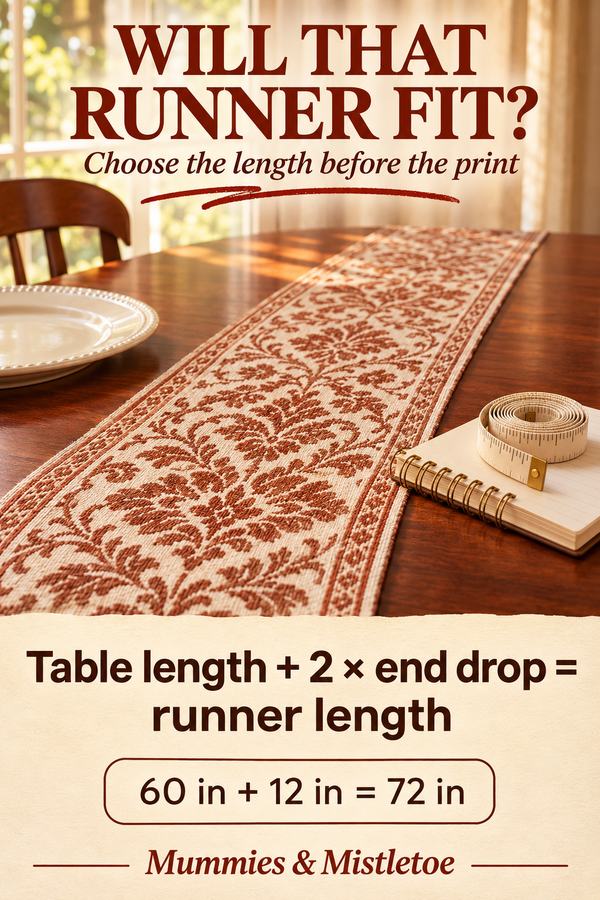
For a runner with equal overhang at both ends, add twice the desired drop to the table's length. A 60-inch table with a 6-inch drop at each end needs a 72-inch runner: 60 plus 6 plus 6. An 8-inch drop at each end would call for 76 inches.
Those drops are examples to help you compare, not a required standard. You may prefer a shorter drop beside benches or a longer one on a display table. Measure from the tabletop down to see where the fabric would finish before choosing.
If the available product lengths don't match your calculation, work backward. Subtract the table length from the runner length, then divide by two. A 90-inch runner centered on a 72-inch table leaves 9 inches at each end. Write that result beside the listing so you can compare options without guessing from styled photos.
Decide Whether the Ends Should Hang
An overhanging runner carries the pattern down the ends of a table, where it is visible from across the room. It can work well when chairs and knees have enough clearance. Check both ends with the seats in place, especially if someone regularly sits at the head of the table.
An on-table runner stops before the edges. This can suit a busy family table, a small round table or a setting with a decorative group in the center. Choose that look deliberately so the exposed tabletop at each end feels balanced.
For example, a 48-inch runner on a 60-inch table leaves 12 inches uncovered in total, or 6 inches at each end when centered. Set the actual plates nearby before deciding whether that uncovered space feels right. A large end place setting can use more of the surface than you expect.
Check the Width With Real Plates
Runner width affects the room left for each place setting. On a 36-inch-wide table, a centered 12-inch runner leaves 12 inches of exposed tabletop on each side. A 16-inch runner leaves 10 inches on each side.
Put down your dinner plates, glasses and utensils, then measure the center space that remains. A small overlap between a plate and a runner may suit your design, but check that the plate sits securely without rocking on a thick edge. Set each glass fully on a level surface.
If you serve dishes in the middle of the table, place the empty serving bowls there too. The runner is part of a working meal surface. Choose its width with the food and the people in place, not just the vase you plan to photograph.
Make a Full-Length Paper Test
Tape plain paper together to match the proposed runner's length and width, or mark the outline with a removable method suitable for your table's finish. Use the mockup to see the proportion before ordering fabric. Don't put adhesive directly on a finish unless the product is appropriate for it.
Set your centerpiece, plates and glasses around the outline. Step back to the doorway, then sit in the chairs. For a hanging style, use scrap fabric or a strip of paper held carefully at each end to see where the drop would land.
The paper test shows size, not the way a particular textile will drape. Read the listing's material information and look at close-up images as well. A firm fabric and a soft fabric can have the same dimensions while sitting differently at the table edge.
Measure Round Tables and Sideboards Separately
For a round table, measure across the center from edge to edge. Treat that diameter as the length in the overhang calculation. A 48-inch-diameter table with a runner 60 inches long would have a 6-inch drop at each end when the runner passes straight through the center.
Check the width against the curve of the table. The exposed tabletop beside the runner narrows toward the edges, so a place setting near an end may be more crowded than the middle measurement suggests. Arrange the chairs and dishes before deciding where the runner should cross.
For a sideboard, measure the top and decide whether you want fabric hanging over its ends. Check drawer and cabinet access, nearby heat sources and any objects that must remain stable. An on-top runner can keep the lower part of the furniture accessible while bringing color beneath a few grouped pieces.
Match the Measurements to the Listing
Compare your chosen length and width with the actual product options, including any stated size variation. Check the fabric's care instructions before buying, particularly if the runner will be used for regular meals. Save the selected dimensions with the order so you can repeat a good fit later.
Look at pattern placement as well as overall size. A design concentrated at the ends may look quite different when the ends hang below the table. A repeating print may be easier to position around a centerpiece, but the actual listing images should guide that decision.
Keep a small measurement note for each surface: dining table, kitchen table and sideboard. Include the runner size you liked and the resulting drop or uncovered space. The next time a new pattern catches your eye, you can check it against a fit you already know.
Leave the paper outline in place long enough to arrange the plates, glasses, utensils and empty serving dishes for one complete meal around it. Then fold it up and write the chosen measurements on the outside.
You can try the calculation with our pumpkin vine table runner, which comes in 16-by-72-inch and 16-by-90-inch options. Mark both lengths on your paper test to see which gives your table the better fit.