The little speckled eggs can come out for Easter, then go back into their box while the flowers stay. That is the pleasure of an Easter tiered tray built around a few familiar pieces: you get a proper holiday display and a simple way to carry it into May.
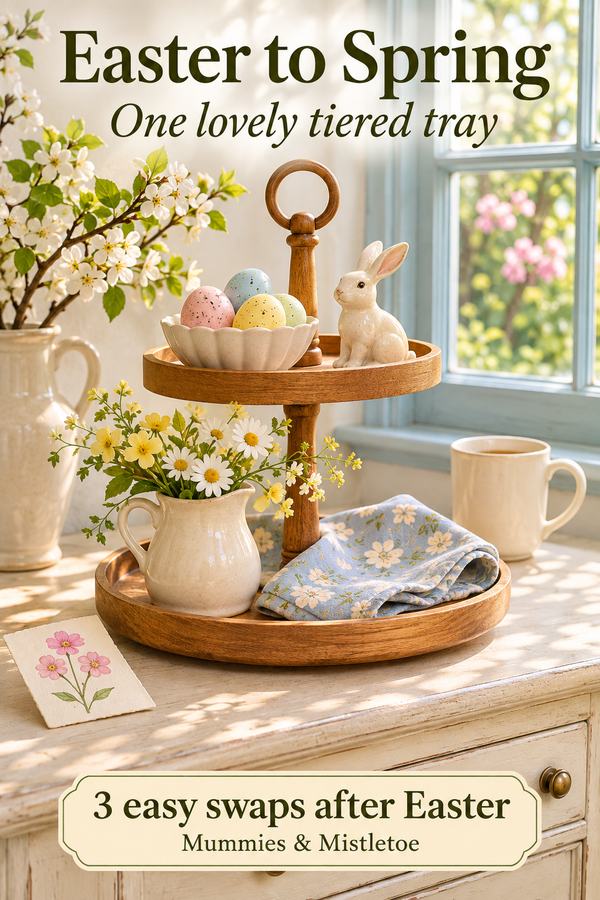
Start with cream pottery, a pale floral or checked cloth, and a small touch of yellow. Add eggs and one Easter figure for the holiday. When Easter has passed, three small swaps will give the same tray a fresh spring look.
Choose the Pieces That Will Stay
Gather a small cream pitcher, a shallow bowl, one favorite mug and a folded napkin or tea towel. Choose pieces that fit easily on your tray, including room below the handle. A broad pitcher belongs on the lower tier; a light bowl or small ornament can sit above it.
Use the textile to establish your colors. A pale blue floral print can bring blue, cream and butter yellow into the arrangement. Pink gingham works with ivory pottery and soft green leaves. Let the pattern suggest the accents instead of shopping for a perfectly matched set.
Keep this little collection together while you choose the Easter pieces. The pitcher, bowl and cloth will still make sense in a spring kitchen after the eggs are packed away. A mug you already use gives the display a familiar, personal detail.
Make the Easter Arrangement
Put the pitcher on the lower tier, slightly to one side of the center post. Add a few short artificial flowering stems, with their tips angled into the open space between the tiers. Small yellow flowers, pale pink blossom or white daisies all suit the soft pottery.
Set the mug beside the pitcher if both fit comfortably. Otherwise, place the mug on the counter beside the tray and let the folded cloth occupy that part of the lower tier. Leave a corner of the pattern visible, with the fabric resting inside the rim.
On the upper tier, place three to five decorative eggs in the shallow bowl. Mix two pale colors or use a single shade with speckles. Keep them low enough to see the bowl's edge. Their rounded shapes will balance the longer flower stems below.
A small rabbit or chick can sit next to the bowl. One figure is enough to make the Easter connection. Turn it toward the room, with a small gap between it and the eggs so each shape can be seen.
Give the Display a Point of View
A tray on a sideboard usually has one main viewing direction. Arrange the flower faces, mug handle and little figure toward the room. If the tray will stand in the middle of a table, turn it as you work so the back has something pleasant to see too.
Try placing the egg bowl near the front of the upper tier and the pitcher farther back below. That slight change in depth makes the arrangement feel less like a row of objects. A short stem can reach into the space between them without covering the eggs.
Check that the tray is steady and that heavier pieces sit low. Keep the display away from the stove and from edges where it could be knocked. Decorative eggs belong in the display bowl; serve treats separately in dishes made for food.
Make Three Swaps After Easter
First, lift out the decorative eggs. Wash the bowl before adding a few small lemons if it is made for food, or leave it empty so its glaze becomes part of the design. A pale yellow interior can bring as much color as something placed inside it.
Second, exchange the rabbit or chick for a small folded flower card. Cut a rectangle of cream cardstock, fold it into a tent and draw a simple stem with three blossoms. Use a color from the cloth below. This can be a child's drawing or your own quick sketch.
Third, change the cloth if the first one has an Easter motif. Trade rabbits or eggs for a small floral, check or stripe in the same colors. If you began with an ordinary floral napkin, keep it and change the flower stems instead, perhaps from pink blossom to little white daisies.
Those three changes remove the Easter-specific details while keeping the pottery, scale and color relationships you already like. Pack the eggs and figure together in their usual padded storage so they are easy to find next spring.
Let the Pottery and Linen Do More
A useful mug or a pretty kitchen textile can be the piece you build around. Notice the small details: a scalloped edge, a painted leaf, a narrow stripe. Repeating one of those colors in the flowers gives you a connection without filling every tier with the same motif.
For a cottage look, keep the pottery creamy and the cloth softly patterned. For a brighter kitchen, use one clear yellow accent against white ceramics. For a vintage feeling, try a faded floral and a small brown-rimmed bowl. The Easter-to-spring swap works in all three versions.
When you take the mug down for a drink, leave its place open. A tray filled with pieces you enjoy using will look a little different from one afternoon to the next. The pitcher and egg bowl can hold the scene together while the cup is at the table.
Keep the Spring Version Light
By May, you may want fewer pieces. Try the pitcher with flowers on the lower tier and the empty bowl above, with the cloth folded beside the tray. The space around them lets the painted petals, glaze and fabric pattern show.
Open the kitchen curtains and look at the flowers in daylight. A stem turned toward the window, a pale bowl catching the light and the cup you reach for every morning are plenty to carry the season.
For the everyday piece in the arrangement, browse our shop's mugs with your tray dimensions in hand. Let a cup you'll actually use lead the color choices, while the paper eggs and other Easter details remain easy to change.