Look Beyond the Chocolate Wrapper
A painted wooden egg comes out of the Easter box beside a ribboned cardboard one, and neither looks quite like the eggs waiting in the refrigerator. The history of Easter eggs helps explain why the same shape appears as food, a gift and something carefully saved for another spring.
There isn't one object that tells the whole story. Looking at a few documented customs and museum pieces gives you a more useful picture than trying to trace every Easter egg to a single beginning. It also gives a family something specific to notice in the decorations they already own.
Begin With Food and Faith
English Heritage’s account connects eggs with new life and explains their place in historic Christian fasting practices. When eggs were among the foods set aside during Lent, eating them again at Easter could be part of the celebration. The fasting practices vary among churches today.
The Church of England’s Easter guide emphasizes the egg as a symbol of the new life Christians celebrate through Jesus’ death and resurrection. A symbol and a food custom can sit alongside each other. Together, they help explain why eggs belong on both the Easter table and the decorated branch.
When explaining this to children, you might say that people can use a familiar object to remember something important. Then invite them to describe what the egg means in your own family's celebration.
Follow the Change From Food to Keepsake
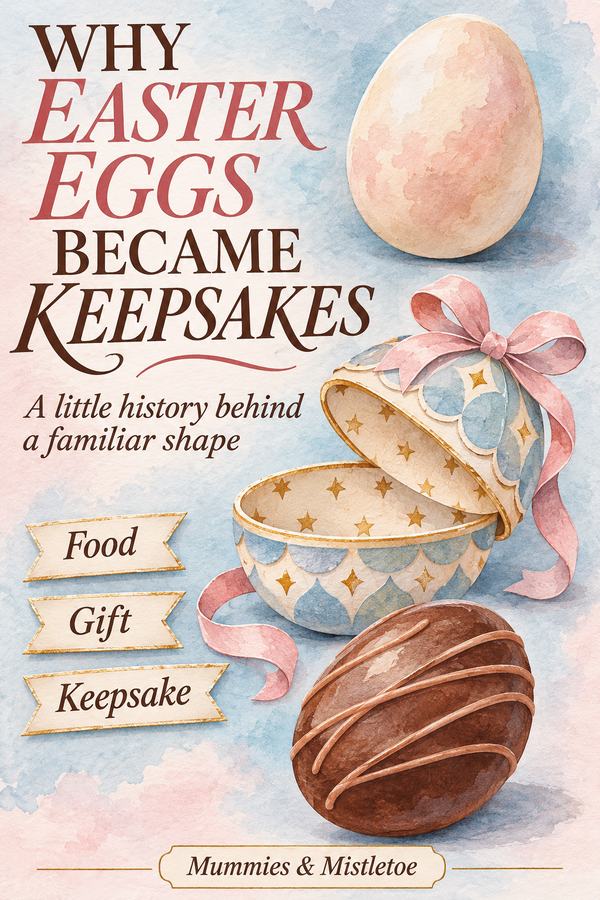
By the Victorian period, the Easter egg could be a sweet to eat or a decorated container to keep. The National Trust describes chocolate eggs alongside collectible papier-mâché and satin-covered cardboard examples. A familiar shape had become a way to package a gift as well as a gift itself.
That change is easy to see when you compare a shell with a lidded paper egg. One is already a container made by nature; the other borrows its shape and adds a seam, lining and opening. The maker can decorate the inside as carefully as the outside, so the recipient has another detail to discover.
Look for those construction details in the collections linked below. A ribbon may suggest how an object was hung or presented, while a fitted lid changes the way it can be opened. Comparing materials gives you a way to read the object before you read its label.
Follow Painted Eggs Into Games and Gifts
English Heritage traces the first mention of pace eggs to early eighteenth-century Lancashire. These hard-boiled eggs with colored shells were given as presents and associated with local plays and egg rolling. Its account also records an egg-tapping game in Devon and Cornwall, where eggs were struck together until one cracked.
Those examples show an egg taking several roles: a decorated gift, a food and an object used in a shared activity. The shell's color mattered when it was presented, and its strength mattered when it was tapped against another egg. The same object could invite both careful decorating and a lively game.
If your family remembers a similar game, write down who taught it and how you played. A grandparent's account of their own childhood belongs beside the broader history as a family memory, with the speaker's name attached.
Look Closely at a Porcelain Easter Gift
London Museum describes porcelain eggs as Easter gifts from the nineteenth century, particularly significant in Eastern Orthodox Christianity. Its example has pink flowers, leaves, a golden crown of thorns and the original green silk ribbon. The museum places it probably in the late nineteenth or early twentieth century.
The museum also discusses toy eggs made of materials such as wood or papier-mâché, with little figures inside. These objects invite a different kind of looking from a dyed food egg: you notice the opening, the interior and the surprise that the shell holds.
Open the museum page together and choose one detail to examine. The ribbon is a useful starting point because it makes the object's scale and handling easier to imagine. The museum's own page lets you examine the photograph alongside its description.
Find Paper Eggs Meant to Be Kept
The National Trust’s collection includes decorative paper eggs as well as accounts of chocolate eggs becoming popular in the Victorian period. At Tyntesfield, one golden papier-mâché egg has an embossed clover pattern; other examples use spring flowers, butterflies or blue foil.
At Lanhydrock, a cardboard egg has fabric flowers outside and gold stars inside. The interior decoration makes the act of opening the gift part of its design. These documented objects help explain why a keepsake egg can feel as much like a small gift box as a seasonal ornament.
For a closer look, compare the outside and inside of one egg you own. Notice whether its colors continue across both halves, whether a ribbon closes it and whether the interior was made to be seen. You can borrow that attention to detail when wrapping an ordinary Easter gift in paper and ribbon.
Save the Story With the Object
Photograph a family egg before packing it away, then write a short note identifying its material, who gave it and anything known about its maker. Separate a remembered fact from a guess: “Grandma gave this to me” is different from “It looks handmade.”
Put the note in the storage box rather than attaching tape to the decoration. Next spring, the painted shell or little paper box will come out with its own story still beside it.