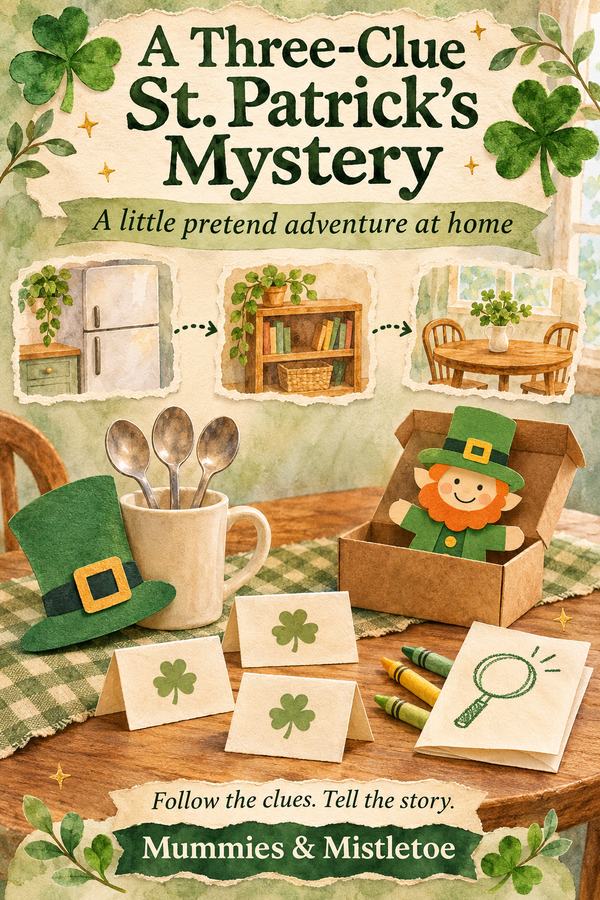
Who put a paper hat on the breakfast spoons? That silly little puzzle starts a St. Patrick's Day mystery with three clues and a paper visitor waiting at the end. Children follow the notes, make their discovery and invent the rest of the story.
The route uses only the table, the outside of the refrigerator and a reachable bookshelf. An adult sets the clues before play and stays with younger children. The game ends with a discovery, then children draw a case file showing what they found and the story they invented.
Set Up the Three-Clue Route
You need three large clue cards, one sheet of drawing paper per child, pencils or crayons, a large paper hat and a small empty box. Draw a broad paper character and place it inside the box. Use age-appropriate materials, with adult help for cutting and attachments.
Set the box at the breakfast table, closed with a loose lid that lifts off easily. Put clue three on a reachable bookshelf, clue two on the refrigerator's exterior and clue one beside the spoon cup. Use a surface-appropriate attachment where needed and keep floors, stairs and doorways clear.
If your home doesn't have a suitable reachable bookshelf, use a familiar basket of books and change that phrase on the cards. Let an adult place and retrieve anything above a child's comfortable reach. The whole route should stay in shared spaces.
Start With the Spoon-Cup Oddity
Put the normal breakfast spoons in a clean cup and rest the paper hat beside or on it without touching food. Leave the bowls where they usually go. The change should be visible enough to notice without creating a mess to solve first.
Say, 'There's a pretend mystery on the table. Let's see where the notes take us.' Ask the children what looks unusual, then open the first card together.
For children who prefer to know the plan, explain that there are three clues and a paper surprise at the end. They can follow together rather than racing. Keep the ordinary breakfast ready for whenever your household wants to eat.
Clue One: From the Table to the Refrigerator
Write this on the first card: 'The spoons are together, but one clue is chilly. Look on the outside of the refrigerator. No opening needed.' Draw a simple refrigerator beneath the words for children who are not reading yet.
Read the card aloud together if useful, then walk to the refrigerator. Clue two should be visible on the exterior at a suitable height, not hidden among food or tucked into a mechanism. Let the child who spots it show the others.
If several children are playing, one can carry the card while another follows the picture. Change the jobs at the next stop. The route gives everyone something to do without requiring one fastest finder.
Clue Two: From the Refrigerator to the Books
Write this on the second card: 'Our visitor wants a story. Find the next note beside the books on the reachable shelf.' Add a drawing of two books and an arrow pointing toward the route.
Place clue three beside the books, not deep inside a shelf that requires climbing or pulling out a heavy stack. Choose the exact book spot before writing the card. If using a basket, write 'in our book basket' instead.
At the shelf, let children name a story the visitor might enjoy. Keep the answer open: it can be a familiar book or one they imagine. Then open the third card to finish the route.
Clue Three: Return to the Table
Write this on the third card: 'The visitor is waiting where we began. Go back to the table and lift the lid of the little box.' Draw the box so its identity is clear. Keep it in the same visible place throughout the game.
Inside, place the large paper character with a note saying, 'You found me. Please tell my story.' Let the children lift it out, choose its name and inspect the hat and clothes they have found.
Let each child give a different explanation for the spoon arrangement. One may say the visitor wanted breakfast; another may think it was packing for a trip. The clues have one route, but the ending belongs to their stories.
Make a Two-Sided Case File
Fold a sheet of paper in half. Label one side 'What we found' and the other 'Our story,' or draw a magnifying glass and a little book as picture labels. Children can draw while an adult writes their words if they want help.
On the first side, record the real clues: spoons in a cup, notes at the refrigerator and books, and the paper figure in the box. On the other side, invent what the character was doing. Keeping the two sides separate lets children enjoy the make-believe while noticing how their story grew from observations.
Add one final picture of what happens next. The visitor might build a shoebox home, borrow a book or make a paper breakfast. This picture can become a later activity without extending the morning game indefinitely.
Let the Children Make the Return Game
Reset the table together and put the clue cards in the box. Later, a child can choose a new safe shared-space hiding place and draw one clue for an adult to follow. Help with wording or placement as needed.
Keep the paper character with the case file. When someone asks about the hat beside the spoons, the child can open the booklet and tell the ending in their own words.