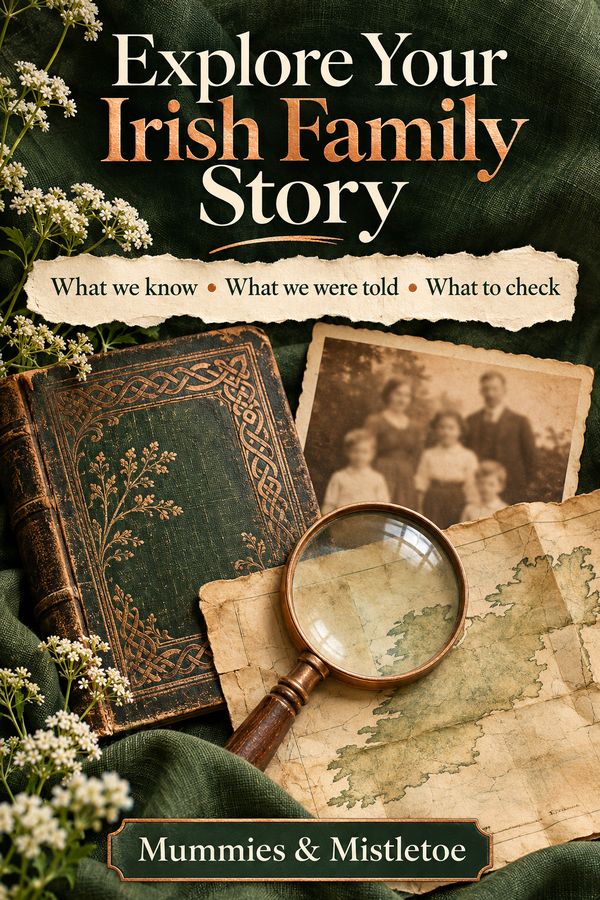
A St. Patrick's Day family-history project can begin with one story about Ireland. It does not have to become a finished family tree by dinner. Choose one person, one question and a place to record what you find.
A good first question is specific: Where was a great-grandparent born? Who appears beside them in a photograph? Which relative first told the story of the journey? A surname alone is not enough to identify an ancestor.
Separate memories from records
Start a page with three headings: what we know, what we have been told, and what we want to check. Put a date and a source beside every entry, even when the source is simply “Aunt Helen, phone conversation, March 10.”
Ask relatives open questions and let them say they do not remember. Request permission before recording a conversation or copying a photograph. Write down the names people used as well as formal names; those clues may help later.
Follow one person backward
Begin with the most recent reliable record you have and work toward earlier generations. Compare several details before deciding that a record belongs to your person: family members, location, occupation and approximate dates can help distinguish people with the same name.
Irish Genealogy's research guide recommends beginning with known family information and using records to investigate it. It also notes that historical names and reported ages can vary. Treat a different spelling as a clue to examine, not an automatic match or rejection.
Use the relevant official archive for the place and record type. The National Archives of Ireland's family-history guidance offers a starting point for understanding available collections. Save the record image or citation, not just a name copied from a search result.
Make a St. Patrick's Day evidence page
For each useful discovery, record the person's name, the record date, the archive or website, the collection and any reference number. Add one sentence about why you think the record is relevant. Keep uncertain connections visibly marked as uncertain.
A notebook, folder or spreadsheet will work. If you want a dedicated place for family notes, choose a journal you enjoy using, including a design from Mummies & Mistletoe. The careful source notes are what make it useful.
Share the question as well as the answer
At your St. Patrick's Day meal, show one photograph or read one short discovery. Include what remains unresolved. “We found a possible household, but we still need another record” is an interesting family story in progress.
Keep details about living relatives private unless they agree to share them. An honest small discovery is more valuable than a complete-looking tree built from guesses.